Dental Restoratives
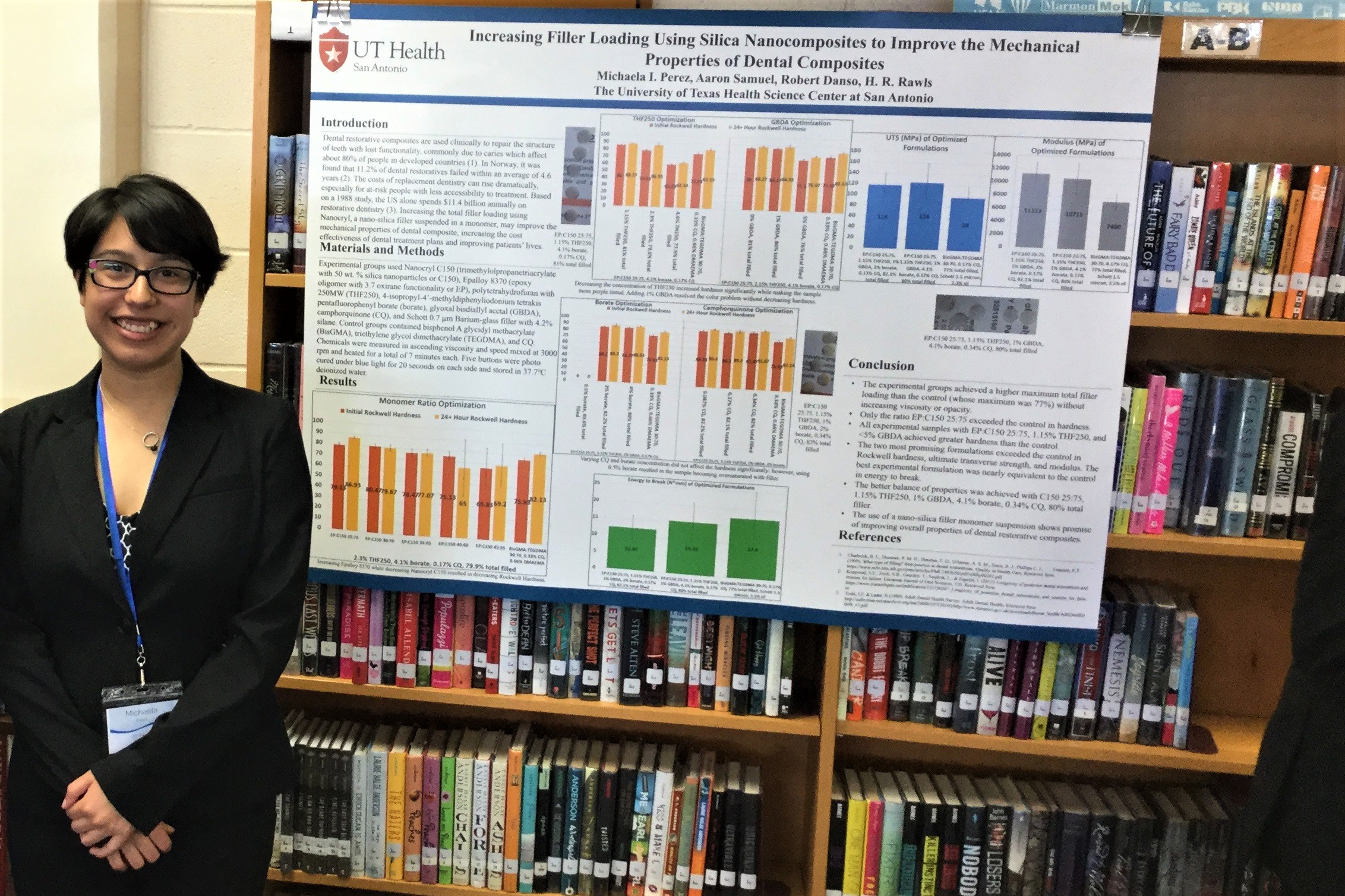
Increasing Filler Loading Using Silica Nancomposites to Improve the Mechanical Properties of Dental Composites
Research study conducted at The University of Texas Health Science Center of San Antonio Oct 2016 to May 2017 under the supervision of Dr. H. R. Rawls.
Introduction
Dental restorative composites are used clinically to repair the structure of teeth with lost functionality, commonly due to caries which affect about 80% of people. The costs of replacing failed dental restoratives (which can happen in 11% of cases within 5 years) are high: billions annually in the US. Our goal was to improve the mechanical properties of dental composites by increasing the total filler loading.
Materials and Methods
- Filler loading was increased by using Nanocryl C150, a nano-silica filler suspended in a monomer
- Composite included an oxirane and acrylate interpenetrating polymer network
- Curing accomplished using THF250 and camphorquinone exposed to blue light
- Hardness, energy to break, UTS, hydrophobicity were measured and color and transulency were noted
Conclusions
- Higher filler loading was achieved without increasing viscosity or opacity; however, only samples with an epoxy to Nanocryl ratio of 25:75 exceeded the control in hardness
- A formulation was found that exceed the control in all mechanical properties and another in all but energy to break
- The use of a nano-silica filler monomer suspension shows promise of improving overall properties of dental restorative composites